Wednesday, February 28, 2007

The Napkin Stories

We've all done it. Grabbed the nearest scrap of paper, tissue, or your girlfriend's skirt and started scribbling the idea that just hit us before it vanishes into the aether of short-term memory. Then you get home at night, empty your pockets, and realize you can't read a darn thing you wrote down all day. Or maybe you shot up out of a deep sleep and had some dream that inspired your new plot twist. You fumble in the dark, stub a few toes, step on the cat, fall down the stairs, manage to find something that feels like paper and scrawl your dream scum onto it. Then you wake up in the morning and realize some epileptic chicken did a tap dance on your notes.

What would it be like if we actually preserved all those little tidbits of ideas and story? How important can those scraps of paper be?

Someone decided to find out. And so the Napkin Fiction Project was born. So far, it has secured mental scraps from almost a hundred writers from across the world, from Robin Black to Rick Moody to Mike Heppner. Springboarding off a desire to capture spontaneous inspiration and those intimate moments that occur in restaurants, bars, homes, and bus rides, Esquire magazine sent 250 napkins in the mail to various writers, asking them to jot down anything they wished at any time and send it back. Here are the results. A mixture of charming, sparse wording, little poems, drama, hilarity and slices-of-life that might've been lost forever, but are now preserved forever... or at least until the downfall of the Internet. Or when the server crashes. Or when napkins are banned from common usage. Hey, anything can happen. It does every day.


I see that smile.

Tuesday, February 27, 2007

Magic in odd places

I enjoy that elusive sense of wonder--that spark of amazement that many of us point to as the reason we started to write speculative fiction in the first place, to share that wonder and inspire it in others. Sometimes, though, this feeling hits from an unexpected source. Like the other day, Jen convinces me to watch this movie with her (which, if you know me and my movie-watching tendencies, is no small feat).

The Adventures of Baron Munchausen


So we're watching this. It's an older movie. Cheesy special effects. Obvious props and backdrops. Much silliness abounds. But you know, the more I watched it, the more it charmed me because it held to a simpler form of magic...one based on a childlike love of fun and adventure. Not "childish" mind you. Childlike. There's a huge difference there, I believe, and it's up to you to figure out where that line is chalked.

It had parts by such notables as John Neville, Uma Thurman, and Robin Williams, among others, but the focus wasn't on Oscar performances or big social commentary. If there was any sort of message, it was that anyone can make a difference no matter how young, old, senile, or preposterous they may seem to "normal" folk. Also, a hot-air balloon can be easily made out of women's undergarments. Take that to heart.
But it amazed me how such a silly movie left me with that familiar little pang in my chest, feeling the desire to see the adventures continue, sad to see those ridiculous characters wave farewell and head off to finish their stories without me. Sure, the plot is wobbly, the logic blown to little wriggly bits by the first ten minutes, and the absurdity of it goes beyond all bounds. But watch this movie sometime, and I think you'll find yourself smiling and cheering along, and wondering how such a silly story can capture our imaginations so powerfully. It's pure fun.
We don't always need epic fantasies with gritty kingdoms and swords and duels. We don't always need a flawlessly worked out system of magic to govern our character's actions and power. Wonder can come from something as simple as a child's need to stow away and see the world, or a Baron's goofball ride while clinging to a cannonball. That's a bit of bliss that can't be conjured any other way.
I see that smile.

Monday, February 26, 2007

Your writing elixir

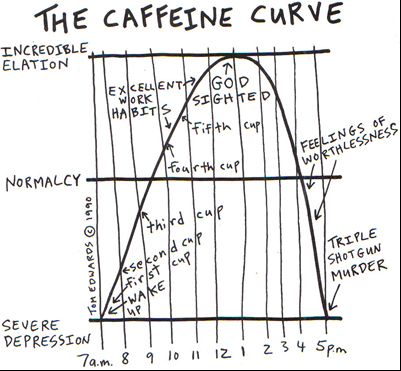
I've always tried to avoid having the quality of my writing be dependant on some foreign substance. There is that lasting writing legacy that some people cling to about alcohol and other vices providing inspiration for stories or some sort of ego and mood booster for the slumping writer. So far, I've managed to limit my so-called vices to diet coke and the occasional splurge of jellybeans, or some other sugar spiker. I fight drinking coffee, or espressos, or lattes with a passion (except for the occasional slurp I steal from my fiance's peppermint mocha). My hope is that I never get into the habit of that "early morning coffee." Why do I go to any length to avoid these things? Partly because my finances haven't joined the Army and become all that they can be, and I've seen so many of my friends and coworkers take out loans to support their habit. Also, I think a writer's emotions can be volatile enough on their own without needing that little tip over the edge that the highs and lows of caffeine addiction provide. I know, I know. I'm sure I'll succumb someday. But for now, I keep this image nearby to remind myself of the perils of those oh-so-innocent frothy cup (with a triple shot).


So what gets you through the day? Do you have some vital pick-me-up that looks suspiciously like a monkey clinging to your neck hairs?


I see that smile.

Sunday, February 25, 2007

Pretty pictures

I'm not turning this blog into a week-by-week accounting of our wedding prep, I promise you. I mean, considering it's a little something of significance in my life, I might mention it as the day gets closer, yah know. Anyways, with this weekend being has hectic as it is, I've few smidges of brainpower left, so I'm just going to post this engagement photo for you to ooh and aaw over, and we'll be back to some semblance of reading and writing come Monday. See you all then.


I see those smiles.

Saturday, February 24, 2007

Weddings and blizzards

So we're in Colorado now, and all general weather announcements are saying: Warning! FAST MOVING BLIZZARD...

We are now faced with the challenge of making it to all the potential wedding venues to check out the grounds while the wind howls and the snow piles on. Plus we've got to meet with a couple folks who will likely be involved in the wedding for things like...oh, the cake, the pastor...little things like that. I've missed the good Colorado snow, compared to New York's slush, but hopefully this won't interfere with what we need to get done. Hope everyone is having a wonderful weekend themselves.
I see that snow.

Friday, February 23, 2007

A little known fairy tale

I don't honestly remember where I first heard about this book. It's one of those titles that danced around in my brain for almost a year. I think I read about it in Neil Gaiman's blog, and then came across it on a random search through Amazon.com, and then somehow I think I saw it mentioned in Publishers Weekly.

Ludd-In-The-Mist. One of the most unique gems of fantasy that far too few people know about or have had the pleasure of reading. I don't use the word "gem" lightly. This story sparkles from all facets. Written by Hope Mirrlees, it was originally published in 1926, and apparently was quite popular in its day. Now it has been released in a new paperback edition, with a Foreword by Gaiman, and a charming new cover. It's a story where the phrase "you son of a fairy!" can cause a furious rift between lifelong friends. Where eating the wrong piece of fruit can twist the way you see the world and never allow you to be satisfied with the way things are, because something beautiful always seems to be just over the next hill.

Fairy-fruit. Meddling fair-folk and their devilish human agents. All manners of subplots that leave your mind whirling, and those fun little clues and sinister implications that speak so loudly to the attentive reader, and left me wishing to know more about the

It isn't a heavy-handed book. The prose is light and enchanting. The imagery is gorgeous throughout. It's not a thick read, either, and you could likely finish it in a few days at most...if you make a conscious effort to go slow. Find it cheap on Amazon.com, or perhaps you'll be lucky enough to mosey upon it in a used book store someday. Then some part of your brain will remind you about seeing this book mentioned on a blog somewhere, and you'll pick it up and be as delighted as I was.

As a side note, Jen and I are flying out to Colorado tonight to check out a couple venues for our wedding. May 6th, folks. Mark it on your calendars. I know I am. I think they need me to show up for something. Anyways, I'll likely get to update over the weekend, but if I don't, you now know why.


I see that smile.

Thursday, February 22, 2007

How to censor a rattlesnake

I once wondered if things like cultural sensitivity and political correctness were getting out of hand. Now I know they've not only gotten out of hand, they escaped into the lab, mated with the mutant chickens, spawned deadly, acid-spewing offspring and are tunneling into the earth's core where they will plot to end all life on this planet.

With One Word, Children’s Book Sets Off Uproar

We have here: The Higher Power of Lucky, by Susan Patron. This book won this year's Newbery Medal, the highest honor any children's literature can achieve. Now the book has been banned in numerous libraries across southern, western, and northeast states, and librarians have taken up arms against one another over its very existence.

Why? Because of a passage where the 10-year-old orphan heroine overhears another character saying their dog was bitten on the scrotum by a rattlesnake.

The passage continues: “Scrotum sounded to Lucky like something green that comes up when you have the flu and cough too much. It sounded medical and secret, but also important.”

One freakin' word. And suddenly we're reduced to living in trees and flinging monkey poo at one another. One librarian called the word insertion a Howard Stern-type shock treatment. Pardon? Are we going to need to put the audiobook on satellite radio so it can get past the censors? Another librarian is quoted as saying, "you won't find men's genitalia in quality literature...At least not for children."

First off, the scrotum is a dog's (Point of sanity: A dog is not a man, however much Dean Koontz might wish otherwise). Plus, the dog has been bitten by a rattlesnake! Poor pup. Can we accede the dignity of getting the facts right before we ban the book?

Fortunately a few voices of reason have their own bullhorns. From the article:
Pat Scales, a former chairwoman of the Newbery Award committee, said that declining to stock the book in libraries was nothing short of censorship. “The people who are reacting to that word are not reading the book as a whole,” she said. “That’s what censors do — they pick out words and don’t look at the total merit of the book.”

I really wonder if there was someone who found this book and turned to his friend one night, after a few martinis, and said: "Simon, I'll bet you the betrothal of my son to your most eligible daughter that I can create a national stink about the first word I flip to in this book."

And Simon said, "Pshaw, George. That there is an award-winning children's story. What could be in there that could possibly make anyone turn their head? The bet is on."

Fwip.
Point.
Scrotum.

And George twiddled his oily black mustache in glee.


The game is on. And the book-burners are now priming their flint and tinder.


I see that smile.

Wednesday, February 21, 2007

The writer's lifestyle

I often troll about looking for the tales of those who have long ventured off into the wilderness of a full-time, or even part-time writing career. These are brave souls in whose footsteps I someday hope to follow. So I seek out their diaries, journals, blogs, drunken spoutings, etc. in the hopes to glean maps and trailmarkers to better prepare myself for what lies ahead in this writing adventure.

http://www.antipope.org/charlie/blog-static/2007/01/the_writers_lifestyle.html is the latest rundown I've dug up, and it gives a nicely cauterized view of the day-to-day responsibilities inherent to the writing lifestyle. Charlie Stross has sold a gazillion (count them..one gazillion) short stories, has a very confusing lineup of fourteen novels sold to various U.S. and U.K. publishers, and has a novel online under the Creative Commons license (yay, another free book!). His life very much runs on the daily application of his Bum-in-chair principle (BIC) and the unvarnished knowledge that writing is hard work and not glorified telecommuting.

Aside from noting that a typical first novel in speculative fiction nets an average advance of $5,000, Charlie reveals the core of the writing routine:

"In general novelists are solitary creatures. You work in a service industry where output is proportional to hours spent working per person, and where it is very difficult to subcontract work out to hirelings unless you are rich, famous, and have had thirty years of seniority in which to build up a loyal customer base. So you eat or starve on the basis of your ability to put your bum in a chair and write. BIC or die, that's the first rule. Lifestyle issues come a distant second...Your lifestyle consists of this: sooner or later (usually later) you wake up, do your usual morning pre-work routine, then commute three metres to your office, wherein you sit for several hours, on your own, hoping the phone won't ring because it will break your concentration for a quarter of an hour afterwards, if you're lucky. Somewhere in those several hours you will hopefully write something."

Check out the link and read further to see his additional writing tasks that will consume your time. It may have a few items you don't expect, or aren't even sure what they involve. If you see anything that confuses you, ask me. Not because I necessarily know, but because I want to research unknown and confusing things so they become known and clear to myself as well. We can help each other out here.


I see that smile.

Tuesday, February 20, 2007

Want a free book?

I've found that Nick Mamatas has made his 2004 novel Move Under Ground freely available as a PDF download. I have yet to read it, but I've got the file and plan to start scanning it to see if it catches my fancy. Who can turn down a free novel, right? He admits his goal may be a bit mercenary, since he hopes to spread awareness of his presence as an author and also that, once you read this novel, you might be so inclined to purchase some of his published and forthcoming stories.

What is Move Under Ground about? Booklist sums it up as: "The Beats meet the elder gods of H. P. Lovecraft, and a harrowing time is had by all."

What else has he written? A young adult novel called Under My Roof, which is a near-future political satire seen from the perspective of a twelve-year-old telepath whose father builds a nuclear bomb and proclaims their house as an independent nation from the United States.

C'mon. How could that not be a fun story?


I see that smile.

Monday, February 19, 2007

Meditative Notes for Writers

Soaping a Meditative Foot: Notes for a Young Writer

Read each point and don't skim. Take at least a minute or two between each thought to actually digest what it's saying. A few that particularly struck me are:

4) Stories, novels, and poems are neither idea nor opinion. They are the distillation of experience.

9) The real poetry -- the names of materials and tools in the trades. Visit hardware stores.

13) The consumption of vast amounts of alcohol or dope or both is not necessarily the outward and visible sign of genius.

26) Study the Grand Masters. For years. After you've decided who they are.


I see that smile.

Sunday, February 18, 2007

Book Recommendations and Rusty Thumbtacks

I signed up with the Amazon Associates program, which gives me an easy way to link books and such to the website and blog. There is a new subsection to the Links page now dedicated to book recommendations, mostly from titles that I've read over the past six months, or from favorite authors. I'll probably throw up some classics from time to time, as well as books on writing, so check it out and see what captures your fancy.

You'll also see a few possibly pop up on this blog, and the titles will shift from time to time as I read new ones and find them worth passing on. So check back and see what's been passing through the reading list.

To end the weekend, this picture was taken by my cellphone from a message board outside the local grocery.


Yup. For real. Just stare at it for a minute and you'll get it.
I see that smile.

Saturday, February 17, 2007

Cars don't explode?

One of the interesting conundrums a fantasy writer faces is trying to make an impossible reality seem as realistic as possible. Now, a science fiction writer deals more with making a reality that either hasn't happened yet, on the technological scale, or is more an alternate to ours. Either way, what you are doing is taking something that only exists in your mind, and building it up so the reader is as convinced as possible that this world actually exists and the characters populating it could ring their doorbell someday to drop by borrow their lawnmower.

I've posted a few times on worldbuilding--creating from the ground up and branching out into details like cultural holidays, methods of warfare, and fashion trends. It's even popular nowadays for systems of magic to have some sense to how they work...some reason that this person can leap tall buildings, while this person can fling fireballs with impunity. I've also talked a bit about how your characters shouldn't do anything unreasonable or stupid for the sake of plot. You don't want to insult the reader's intelligence.

On that note then, here is today's question. Magic aside, do the physics of your world make sense? Take a peek at this link to get a sense of what I mean. Yes, I know. The link is about physics in movies, but it's pretty enlightening (if incredibly, mathematically detailed).

The Fight for Decency in Movie Physics!

As they say on the site, yes, the people who came up with this have lives, and yes, they do enjoy movies. They're not out to destroy your love of all things cinematic. But we writers can learn from this. Are there in situations in your story that just don't physically make sense? I know, part of the fun of fantasy and such is that you can tweak those scenes with magic to make it all right, to help the hero survive the fifty-foot fall, or run across a continent in a few seconds. Still, there needs to be something in the story that anchors it in a world the reader can relate to. It can be simple stuff, little details.

If you have fighting or gunfire in your story: Have you research the actual make of the gun, the ammo, etc? Have you ever actually fired a gun yourself and know how it affects the body? Have you ever been in a fight, or sparred, or any other physical confrontation that left you breathless?

Obviously, there are lots of things that our characters are going to go through that we never will. I'm afraid that I'm never quite going to know what it's like to defeat a Dark Lord singlehandedly, nor do I think I'll be riding a spaceship through a wormhole anytime soon. But maybe I could go horseback riding at some point to remember what it's like to handle one of those beasts. Maybe I could even go to one of those Ren Fairs, or medieval reenactment societies so I get a feel for battle scenes, holding heavy weapons and wearing burdensome armor. Maybe I could visit a zoo, or volunteer at a hospital, or so on. These all give me opportunities to learn what happens in areas of life that I don't have much experience in otherwise. And if my stories lead me there, perchance, then I'll be able to portray a high-speed chase a little better, or show the proper way to defuse a nuclear bomb. Who knows?


I see that smile.

Friday, February 16, 2007

Big news for the day

It actually has nothing to do with writing. The big surprise today is that I got engaged last night. It involved snow, a hollow book, and us getting our butts frozen, but myself and Jenelle are now engaged. Now all the fun begins as we plan the actual day. At least both of us agree that we want a rather short engagement. I know. I too am amazed she said yes. What was she thinking?

Jen with her hair a little longer than it is at the moment. I'm sure there will be more pictures as time trundles on.


I see that smile.


Thursday, February 15, 2007

Heart-Shaped Box: A Review

One of the things I love about working in publishing (more than the copious amounts of free diet coke I swig during the day) is the fact that just down the hall from my cubicle there is a bookshelf stacked high and mighty with books and advance review copies (ARCs) that one can snag at will. About two months ago, during my daily perusal of this blessed font of stories, I came across a copy of Heart-Shaped Box, by Joe Hill. This book came on sale day-before yesterday, and I started seeing references to both book and author everywhere.

So here's my take on it.

First off, the word has now been out for a bit that Joe Hill is actually Joe Hill King, Stephen King's son. And yes, Hill has purposefully made that distance between him and his father. They aren't published by the same company, and Hill was long-ago proving he had a strong style and great stories to tell before anyone knew who he was.

Heart-Shaped Box is raw. It is vicious. If you don't like horror and are easily creeped out, well, support Hill by buying the book at least, but just give it to a friend who likes the stuff, or put it on a shelf and enjoy the cover art. The story is intense: Jude, an aging rock star who has a rather morbid collection of death-themed paraphernalia (skulls, nooses, etc.) comes across an online auction where a woman is selling the ghost of her recently deceased father. But when the ghost turns out to be all-too-real, and possessing of an inescapable sense of vengeance, Jude must revive his own tattered past, as well as that of the deceased man, to find some way to get rid of the powerful spirit before he gets killed.

Even though I started out disliking Jude, as he comes across as an egotistical, selfish loner who is basically throwing a lifelong pity party, by the end you get to see his noble side emerge as he takes control of a life that was, up until the ghost came along, sliding listlessly toward the grave. And the ghost? Despite what some might think, not all ghosts come back to avenge a wrongful death or to make up for past misdeeds. Even the dead have secrets--some of them very ugly ones. It was a fast read, even for me. It has a gritty style and some scenes that will force you to get pliers to detach your fingers from the binding once you're done. A great read that shows Joe Hill is in a category all his own.


I see that smile.

Wednesday, February 14, 2007

How not to solve your plot

Plot--the core of your story. The events that take you from beginning to end. Often a novel-sized story involves a rather complicated bundle of events that doesn't so much resemble a beautiful tapestry, but more a ball of yarn that a hundred demonic kittens have strewn across a tar pit.

How then do we untangle this mess of events, characters and plot knots? In essence, the writing of a story is an attempt by the characters (and therefore, by the author) to solve an ever-increasingly difficult series of threats, crisis, and otherwise nasty situations that have been dropped on their heads--by you, of course. You fiend.

Here's a couple of ways you shouldn't go about doing it.

Deus ex Machina: Say you've got a space opera going on. Your characters are going through much emotional turmoil while flying around with some scientifically plausible hyperdrive, fighting in a war, or perhaps dealing with subterfuge, unspeakable alien horrors, etc. Every so often a few hints are dropped in about, oh, maybe an ancient civilization, or some ultimate weapon lost to all time. No efforts are made to make contact with this old, wise civilization, nor to uncover said weapon. Yet right as the characters converge and people start dying in spectacular ways, and the reader holds themselves breathless to see how they'll extricate themselves from their dire circumstances--voila! Megalith spaceships appear out of nowhere and blast the baddies into spacedust. It's the ancient civilization, come to rescue the heroes by virtue of their...um...hero-ness. A deus ex machina is something shoved into the story simply to provide a way out. It has little or nothing that actually affects the story or characters, and only serves as a weak excuse for an actual well-thought-out solution that is derived from a character's skill, cleverness, foresight, and so on.

Babble: "Holy moley, captain! We're dead in space and the evil Shinkickers are warming up their blasto-ray!" Says the captain, "Fear not, expendable crewman. Let's revert the halucingraphimagickator, give it a swirly, do a foxtrot on the gyroscope, and, above all else, reverse the friggin' polarity." And thus the ship is saved for the sequel. And thus the readers go away either feeling incredibly stupid or used. Or both.

The Computer Game: Behold, mine apprentice. Thereupon sits the Grim Lord Foul Smoggy, who happens to have one known weakness (which has been passed down these many generations through my family line alone, of which I am the last, and therefore have earned the right to act annoyingly aloof and mysterious and never answer any of your questions straight). And since you are prophesied to bring about the death of the Grim Lord (known by some as Smoggle) I shall tell you how to exploit this one weakness. First, you must uncover the Quill Pen of All-knowing, with a +5 wittiness booster. Then you must forage through the woods of Evergloomy Weeping Willows and find the Root of Common Sense. Then you must hike the highest peak of Mount Wayuphigh. Nothing to do there, really. Just take in the view and get in some senseless fights for some action scenes. Oh, and then, don't forget to do a dungeon crawl and scour up several blue keys, powerups, extra lives, magic spells, and some health and mana potions to help you in your climactic fight against Smoggle. Don't forget to save your progress along the way in case the system crashes and you have to restart. Do you really want to end up at the pig farm all over again?


These are all ways to solve a story that I strive to avoid in crafting a plot. These three especially are endings that, when I discover one in a book I'm reading, really shove flaming toothpicks under my toenails. Got any other presto-cheapo story gimmicks that irk you? Lemme hear 'em.


I see that smile.

Tuesday, February 13, 2007

Craft exercises and Godzilla's Guts

All writers have those days where you stare at the screen and the fingers are poised on the keyboard, and you went to bed last night knowing right where you were going to pick up from in the story...and...nothing. The words have their heads under the pillows and are pleading for five more minutes, mom. As a mental alarm clock then, I turn your eyes upon these most holy and venerable 15 Craft Exercises.

No, you don't have to do them all in one sitting. But keep them in mind. Bookmark them and set them in a little corner of your desktop so when you have one of those days where your mind is spinning its wheels, you can dig these exercises out and at least give yourself some outlet for the day.

My favorites:

- Sit in a restaurant or a crowded area and write down the snippets of conversation you hear. (I've done this, and I can point out a specific ridiculous conversation that I lifted and pasted almost word for word into one of my as-yet-to-be-published novels...and no, I'm not giving any credit. Trust me. They wouldn't want the attention.)

- Keep a diary of a fictional character.

- Take a piece of your writing that you have written in first person and rewrite it in third person, or vice-versa.

I've also combined that second bullet with the interview suggestion. There have been many times that I've started to flounder with a story, and to get my mind back behind a character's motivation or emotions, I've sat down and typed out a conversation in my head as if I'm interviewing that fictional person. I ask them how they're feeling and they generally say they hate me for putting them through so much crap. I mean, sure, I ask questions like, "So, what are your thoughts about me killing off your family in chapter three? Wasn't that spiffy?"

They also tend to get up and storm out of the interview before I can get much out of them, but it's a fun little exercise, nonetheless.

And in the interest of adding something fun to this post that really has nothing to do with anything that has come before it, I present you with a dissection of Godzilla and several of the rubbery monsters he fought over the years.


I see that smile.

Monday, February 12, 2007

Dictionary: Impossible

Fighting some writer's block lately? Need an inspirational kick start? Then this is a little game/contest that I really wish I had thought of. However, it was the wonderful genius behind Paperback Writer who has come up with Dictionary: Impossible. How to play? Well, you can go over to her link and read her instructions. Basically, flip through a dictionary and write down the first ten random words you see.

My words:

Impair
Numerous
Obvious
Marrying
Contradictions
Forgiveness
Somewhere
Crushing
Horizon
Items

Step number two, turn those words into at least three novel titles.

My titles:

1. Numerous Contradictions
2. Crushing Horizon
3. Marrying Somewhere
4. Obvious Items
5. Impair Forgiveness

Lastly, create a story premise for each title.

My stories:

1. A Make Your Own Adventure story where you wake up one day and discover that the entire world disagrees with you on everything and anything. No matter what. You’re just wrong. Every page choice results in your death.

2. That sunset seems to be getting closer everyday…but it must be some kind of atmospheric optical illusion. If that’s the case, though, why are all the sunrises starting to get so unbearably hot?

3. Susie was supposed to be getting married today. But after a freak accident with the coffee maker and a semi truck that barreled through her living room at exactly 4:14 AM, she can’t quite remember where she’s getting married, or even who it’s to. But that truck driver is looking awfully handsome.

4. Turns out that household items such as silverware, kitchen appliances and doormats are in fact intelligent, extraterrestrial species that have been quietly invading the planet until they are ready to strike. That happens to be tomorrow morning, by the by. Enjoy your breakfast, human slaves.

5. Two men and their trained demon-flea circus decide to go on a mission to block God’s forgiveness from reaching humanity for the rest of eternity.

Now, she gives the option of taking this even further and will declare you the winner should you actually write the full stories for all of these titles. Anyone? Do I see that hand in the back? No? I just know someone is going to do this.

I see that smile.

Sunday, February 11, 2007

Join the ranks of Evil Overlords

This post kind of ties in to my previous one about stupid characters. The whole idea that we should never insult our readers' collective intelligences by making the characters do nonsensical things for the sake of plot. Now, the Evil Overlord List may derive a lot of its points from sources such as James Bond villains, Star Trek baddies, and otherwise, but this could be a good primer on "ways to avoid the cliché supervillain in your book" list, if you're so inclined to read it that way.

Here are a few if my favorites, torn out for your viewing pleasure. Now, raise your right hand and repeat after me...

#30. All bumbling conjurers, clumsy squires, no-talent bards, and cowardly thieves in the land will be preemptively put to death. My foes will surely give up and abandon their quest if they have no source of comic relief.

#98. If an attractive young couple enters my realm, I will carefully monitor their activities. If I find they are happy and affectionate, I will ignore them. However if circumstance have forced them together against their will and they spend all their time bickering and criticizing each other except during the intermittent occasions when they are saving each others' lives at which point there are hints of sexual tension, I will immediately order their execution.

And how many times have we seen this one?

#45. I will make sure I have a clear understanding of who is responsible for what in my organization. For example, if my general screws up I will not draw my weapon, point it at him, say "And here is the price for failure," then suddenly turn and kill some random underling.


Thank you, ladies and gentlemen, you've been a wonderful audience today. Go check out the rest of the list and enjoy some good belly laughs. Or at least a few chuckles. I'll see you Monday.


I see that smile.

Saturday, February 10, 2007

What does it take?

Scott Westerfeld lays out the numbers that define his career. An intriguing look at both how he has managed to reach writing full time and what it took for him to get there in a financially feasible way. If you, like me, have this as your goal, then this will give you a good measure of the reality of the situation and what your dreams may cost you as far as time and effort.

I'm off to martial arts. Enjoy the day.


I see that smile.

Friday, February 09, 2007

Coming in late on a series

I need to ask you all a question. I'm going to list a few authors and their series, and I need to know if it's going to be worth my time tracking down these books to read. Thing is, most of these people are at least five or six books into their series, and thusly shall require many late nights, long subway rides, and sore eyeballs to get through all their works. And, as a reading addict, once I begin (unless I come across one that stinketh like a dog fart) I am pretty dedicated to finishing off an author's entire list of works to get the entire experience.

So. Here we go. I need to know if the following authors and series are worth the while.

Steven Erikson, focusing on his The Malazan Book of the Fallen series, which I believe is coming out with the fifth (?) in the series come April. I can get the first one, Gardens of the Moon for three bucks off Amazon.com. They look like rather hefty books.

Next up is E.E. Knight and his Vampire Earth series, beginning with Way of the Wolf. Another two-buck buy off Amazon, so I know it's not going to cost a lot money-wise, but I don't want this series burning me out on the vampire mythos entirely. Tell me it's consistently original enough, and I'll give it a go.

Lastly, I've been seeing Neal Asher show up with some interesting science fiction titles, mainly those set in a world of Polity and rubincles: Gridlinked, Polity Agent, and so on. Looks like substantive work, but intriguing.

Have I made any good choices here, or are they all bunk? Give me some lanterns through the fog here, folks.


I see that smile.

Thursday, February 08, 2007

Buzz, Balls, and Hype

My last post got a nice response by Becky, who also had mentioned some marketing thoughts in her blog, though more on a cautionary vein...a good reminder that, in all our efforts to reach a larger audience, we shouldn't forget that often the best writing reputations and such are built on word of mouth and that precious connection writers have with readers as individuals.

What with all the talk about marketing and promoting your writing, I decided to unload a few more links I'd saved to go with the theme. Starting, we have this awesome blog:
Buzz, Balls, & Hype. While it runs a lot of book reviews and dissects, as it mentions in the title, the hype surrounding some of the more questionable bestsellers, it also is a wealth of insight on what helps a book sell on the market today. For instance, some of the latest posts have to do with the key asset for having a successful podcast (again, the relationship and trust with listeners) and the most recent post which shows an awesome trailer for a new thriller coming out by Lisa Gardner, and reveals how effective an author interview can be when done properly, with good mood music, and lots of sharp knives and other instruments of death.

And, yes, while this next link comes from a Romance magazine, the approach to marketing it helps you run through in your mind looks like one that can easily cross genres. It's nice to actually sit down and clarify in your mind who exactly you are trying to get your stories across to.

So that should be enough on marketing for a bit now. Though I'll probably forget I just said that in about a week and find some more links to share. Let's see how long I can last. Is it bad to enjoy this kind of thing?


I see that smile.

Wednesday, February 07, 2007

Blogs, the pros and cons

Two links for you to taste test. One of my ongoing fascinations in the business world is with marketing, publicity, and those other means of grabbing people by the lower lip, stapling their eyelids open and going, "Look! Look here! No, not there! Here! Where I am!"

Okay. Those might constitute drastic measures, but it's not much worse than what a lot of companies will do to get your attention for a few subliminal seconds. Anyways, in the wide world of publishing, blogs have obviously risen to the top of the weapon heap as being one of the best ways to make one's writing presence known, reach out to readers, and hopefully find people interested in hearing what you have to say on a constant, if not daily basis.

Obviously, I am heavily involved in this practice, and I've come to enjoy it for a couple reasons, one being that the daily blog reading and writing routine keeps me up to date on a lot of the news and events going on in the publishing realm. I also know that a lot of you who drop by and scan these dollops of thought also have blogs of your own, and we all want to know how to make them bigger, better, faster, stronger...Yeah. Today's links have to do with these virtual personae, and how we can make sure they represent us, and our writing, well.

For one thing, bad blogging habits can create a significant downturn to your money ventures. Learn what these no-no's are, and how to avoid them, especially if you have a full or part-time job along with your developing writing career.

Second, here's some great general advice on how to both structure your blog to draw in a larger audience, and then, once you have your blog established, there are recommendations on ways to increase the value and widen the road for more traffic.

All right. That's it for today. I now brace myself to venture outside and walk to the subway. I swear, it's been so cold lately here in NYC that the wind hits you like a brick of ice. Brrr. But I have a scarf! I shall triumph! Or if I don't put up a blog tomorrow, you can assume the wind won.


I see that smile.

Tuesday, February 06, 2007

Stupid Characters

Be honest. Have you ever made your characters do something that no one in their right mind would ever conceive of doing, much less follow through with? Did you have them do it for the sake of furthering your plot, or just to act out a silly scene you thought was oh-so-clever?

I have. I admit it. I'm not talking about when a character chooses to do something wrong...like betraying another character, or something selfish, like stealing or even killing. Those are character actions, based on who they are and their values.

But stupidity...that's a plot-killer for sure. It's like all those Star Trek episodes where Kirk and Spock fight to get some insanely powerful weapon or technology. They get it at the end of the show...only by the next episode they've totally forgotten they ever had the thing, and so are as bad off as ever when the next big bad alien comes along. Any spaceship captain worth his stripes would have that thing strapped to the hull, primed to blast some tentacled space-freak into photons.

See, what we need to assume as writers is that everyone who reads our book is at least twice as smart as we are. They're going to catch every plot hole, every inconsistency, even deus ex machina. And when they do, they aren't going to be happy. Storm-the-castle-with-pitchforks-and-torches unhappy. Never a good reaction to provoke in your readers.

As blogging writer Vanessa Jaye states it: Stooopid characters--check out her example in the link.

So check your stories. Put yourself into the character's shoes, however big or tight they might fit, and see if their reactions are a little off kilter from reality. If you found a body in your closet, especially of, say, a close relative or romantic interest...instead of reporting it as soon as possible and providing a proper alibi, wouldn't you rather forget about it, go have lunch, and then return home once the police have already been called in and your neighbor distinctly remembers you leaving the house at such and such a time that clearly makes you a suspect?

No. I didn't think you would. So make sure you characters aren't doing dumb stuff either, even for the sake of increasing tension and conflict. There is real tension and conflict (the good kind) and there is fake, badly plotted, dumb-character tension and conflict (the bad kind). Especially in fantasy and science fiction, we need to imbue the story and characters with a sense of realism. People still act like people, and unless there is an amazingly good reason for the character to delay reporting the body in the closet, then the reader should have no reason to suspect that you're trying to pull a fast one over their superior intellect. Never underestimate your readers, or your characters, for that matter.


I see that smile.

Monday, February 05, 2007

Conversations in the Book Trade

Welcome back to the week, everyone. I hope everyone enjoyed the Super Bowl. Not a huge sports person, myself, but I think everyone uses the game as another good reason to just get together and have fun--can't have too much of that.

Anyways, I'm back to work, and for those of you who didn't know, I work as a copy assistant at a publishing company. It's pretty interesting to see what goes on behind the scenes and to contribute in my own way to a book getting produced and then seeing how well it sells. One of the best things I think anyone can do when they want to get an edge in writing is to understand the mechanics side...the business of it. What goes into the marketing, the cover art, the bylines? Why do they use that font size? What audience are they pushing this to sell in? How many advertising dollars should be invested in a certain book, and should the company invest in television or radio commercials for a title?

This kind of stuff fascinates me to no end, for some twisted reason. So imagine my joy in finding this blog:

Conversations in the Book Trade

What you have here is a long list of authors, editors, agents, publishers and more who are interviewed in-depth on the many facets of the publishing industry. They're asked everything from the latest project they're working on and why they think it will succeed to the steps they think need to be taken to improve on the industry as it stands today.

This is a great chance to peer into the brains of the people who populate the very business we writers are trying to conquer. Why not use the information they're freely giving us rather than remaining in the dark about this big, mysterious industry?


I see that smile.

Sunday, February 04, 2007

I have never seen its like

Now this is intriguing.

A Humument

A visual-poetic book, where the artist has taken a Victorian novel (A Human Document, by W.H. Mallock, 1892) and has reworked it into a literary collage of visual gems, where each page is a self-contained message or poem. The first edition was seen "to be a defining product of post modernism linking traditions as various as medieval illumination, experimental poetry and non-linear narrative with the procedures of modern art."

This picture from the site compares the Before and After of page 130:


The link above goes to the website for this ongoing project, which seems to be under constant revision. The website lets you individually view every page, as well as read essays explaining how the project got started, and the ways the artist (Tom Phillips) evolved his vision for the book. Looking through the galleries, I found myself stunned, not just at the snippets of words and thoughts expressed on each, but in how detailed and involved each page was. You can literally stare at a single page for the longest time before your eye is able to integrate all the alterations and depths that have been built up around the text. And if you look close enough, you can see the original text faded in the background of all the newly applied art. This is a visual delight, but more than just eye-candy. It harks back to those heavily illustrated Bibles that monks took lifetimes to craft. Take the time to let each page soak in before moving to the next, and wonder how else one might meld the literary craft with another artistic form. Any ideas, or something you've already done or seen?


I see that smile.

Saturday, February 03, 2007

Your face for cheap

If you're looking for any neat marketing tools or ways to get word of your novel or writing endeavors spread throughout the known world, you might check out this nifty deal.

Your face here

It's a cheap way to get a goodly stack of business cards printed up, all with either your face printed on them, or maybe some cover art, or anything you think would snag people's attention. The art is uploaded straight from your flickr account, and it makes for a great custom reminder for people to use as bookmarks while actually reading through your hefty tome.

Oh, and also, if you are someone who loves to really dig into the business side of publishing, check out this ultimate resource, subscribed to by publishing companies, editors, and agents everywhere: Publishers Weekly

This website and magazine, with some content requiring subscription, has book reviews of the latest releases, tracks bestselling lists, and even publishing job opportunities.


I see that smile.

Friday, February 02, 2007

Inventions for Authors

It's the end of the week. Brain has officially been set to Deep Fried. Lots of good work done. I woke up each morning, which is probably much less of a challenge than I make it seem. Several apartments seen with the girlfriend, with one really nice and cheap (cheap!) one receiving the deposit so she will actually have a place to live come another two weeks. I've reached the halfway point of my latest novel...or maybe it's 2/3rds of the way through. I'm not sure yet. I guess it depends on when the ending decides to show up.

With this week being filled with worldbuilding, psycho squirrels (you excluded, Buffy), and beyond-the-grave plastic surgery, let's end on a lighter note, shall we?

Inventions For Authors

Specifically, these inventions are for improving your book tour by making you more smiley or providing a backup audience for your readings. Or (since I can't seem to get over the wife-face-surgery thing) you could always have surgery to make yourself look like a famous author of choice, grab a stack of their books, and enjoy the vicarious fame.


I see that smile.

Thursday, February 01, 2007

The Publishing Poker Tournament

I don't like to play poker much. I mean, I do, so long as I'm not actually betting the rent check on a hand. Play me for Skittles, or my last can of diet soda. I'll be fine then. But plunk down some real cash, even chump change, and I start folding faster than a master origami artist.

Why? Because I know I'm just good enough to get myself in trouble when it comes down to those close calls and reading the other players. That aside, poker can be incredibly frustrating. One of my old roommates spent a long while playing online poker. He read dozens of books on the subject and often spent evenings working a calculator to figure out the chances of particular hands popping up, and how those hands statistically related to any other hands any other player might hold at that moment. And, as he played in the living room on his laptop, I could always hear his victory yells or shrills of defeat from my bedroom. One pattern I saw (or heard) play out over and over was this: He would get a great pair of cards on the draw. Then he got every card he needed to set up the strongest hand possible in this turn. He'd bet and raise like a madman, certain of victory. Then the last card would fall and give another player (who once had the worst possible hand) the win. Much shrieking and decrying of the cruelty of the universe would ensue.

And this is how any of that ties into writing: Often times, I believe the publishing industry is like a poker game. It's a subtle combination of skill, calculated odds, and blind luck. The skill is one of the few things we as writers have control over. We give ourselves the best chance possible by constantly trying to improve our prose, building better stories, designing a more detailed world, corkscrewing the perfect plot twist. Those are things we can affect. The calculated odds comes through what you and others do to push the story into the world, whether through your publisher's marketing efforts, a book tour, great cover art, and so on. You do your best to set up the book itself for success.

The last one is what can really bite authors in the bum, so it seems. Blind luck. Bad luck, especially. (Don't believe in luck? Then call it bad timing. God's will. Whatever label sticks for you.) Your book comes out, and it gets hundreds of horrible reviews because all the critics spilled coffee in their laps on the way to work. Or your book is titled Cuddly-Wuddley Puppies and Why We Love Them, and a new scientific study comes out the day before that promotes the All New Anti-Puppy Diet. Or puppies try to pass a controversial bill in Congress and their ratings in the polls fall, or some other catastrophe, social movement, fad, etc. that makes people snub your book no matter how wonderful it is.

It's easy to get bummed out realizing that you can do so much to set up what looks to be a surefire bestseller, only to have it knocked down by elements that are entirely out of your control and seem unfair. This brings me to several statements/opinions, which are worth what you paid for them. First, never wrap up your self-esteem as a writer in a single book or project. Recognize that these flubs happen, and will likely continue to happen at times, no matter how successful you become. Second, persevere and turn this uncontrollable series of events into a lesson for your next novel. Look at the mistakes that were made and improve on them. Look at the situations that tripped you up and prepare for them next time. In this way, you are doing your part as a writer to improve both your writing craft and biz skills, thus increasing your chances the next time around.

Oddly enough, it's Harry Houdini, the legendary magician, who had a creed that fits well with this situation. He often quoted an old school song that goes like this:

"Keep working, tis wiser then waiting aside,
Or crying, or wailing and awaiting the tide,
In Life's earnest battle those only prevail
Who daily march onward, and NEVER SAY FAIL."


I see that smile.